
Octopus and Ice Sheet Team: Ancient West Antarctic Ice Sheet collapse revealed
Who Professor Jan Strugnell from the Octopus and Ice Sheet Team
What Using modern octopus DNA, the Octopus and Ice Sheet Team discovered that biological connections between Antarctic octopus populations can only be explained if the West Antarctic Ice Sheet had previously collapsed. Their research dated the collapse at 120,000 years ago, the last time temperatures were 0.5–1.5°C above pre-industrial levels.
Winner of 2025 Aspire Scholarship Eureka Prize for Excellence in Interdisciplinary Scientific Research.
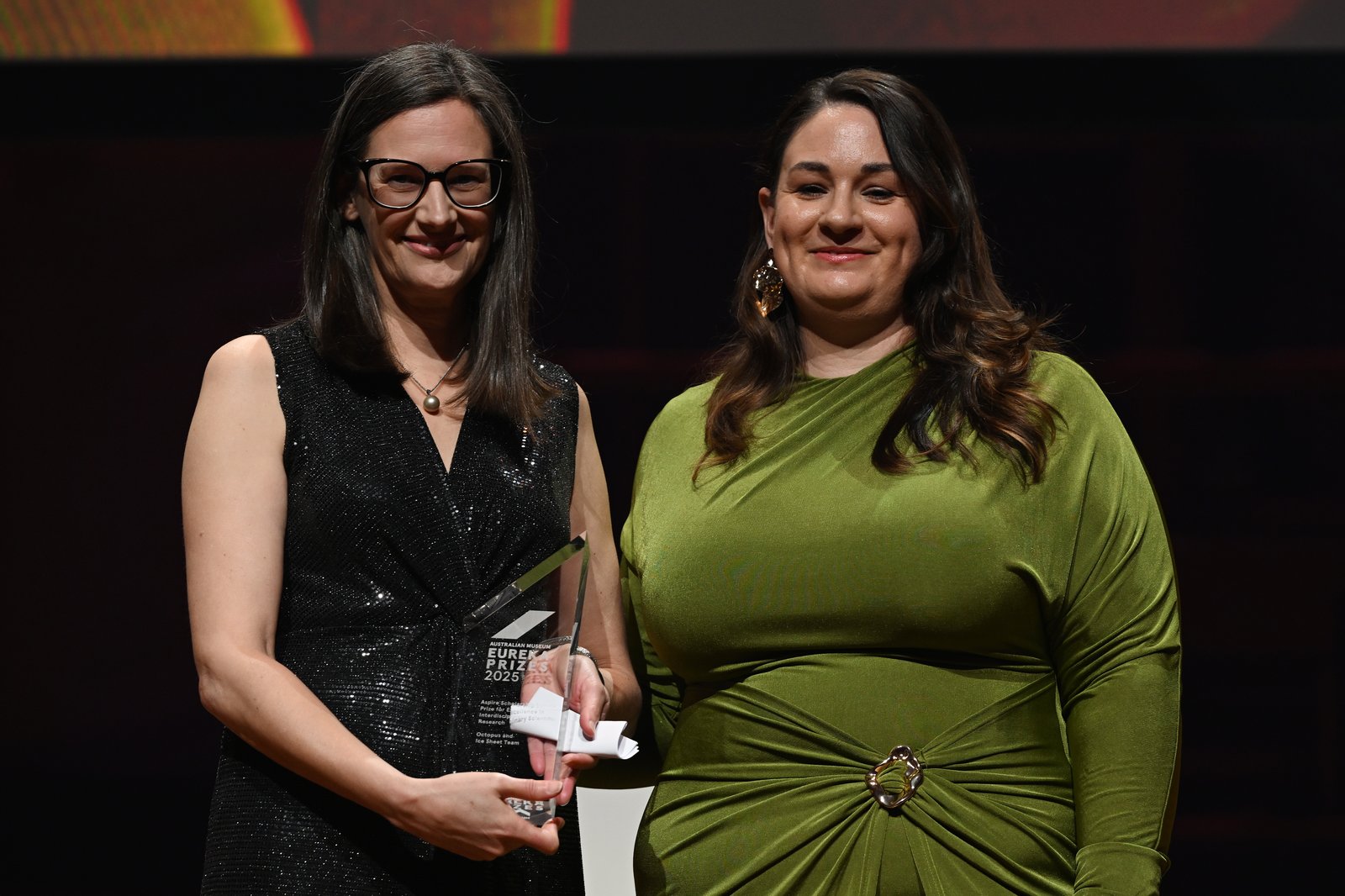
Dr Neridah Wilson of Octopus and Ice Sheet Team accepting the 2025 Aspire Scholarship Eureka Prize for Excellence in Interdisciplinary Scientific Research, with presenter Emily Kelly. Photo by Getty
Image: Wendell Teodoro/Getty Images for Australian Museum© 2025 Getty Images
Your team has made an amazing discovery about the previous collapse of the West Antarctic Ice Sheet (WAIS). How did studying octopus DNA help you trace this collapse, and what makes this type of evidence more conclusive than traditional geological data alone?
The genome of an animal is like a time capsule. It contains a record of all of its ancestors. Humans take advantage of this to learn where our ancestors come from. We were able to take advantage of this to investigate past signatures of connectivity in octopus that live on the seafloor around Antarctica. We found that out of a range of models we tested the one that fit our data the best showed connectivity across Antarctica – which suggests a seaway existed in the past. The last time this seaway was thought to have existed was in the Last Interglacial period which was about 125,000 years ago. At this time CO2 levels were similar to pre-industrial times. The presence of the seaway indicates that the West Antarctic ice sheet had collapsed. Previous geological data had been inconclusive about whether marine sediments were present on the seafloor under the ice.
Given that the ice sheet collapse happened when temperatures were only slightly above pre-industrial levels, what does your research suggest about the potential for similar events under current climate change projections?
The implication of our findings suggests we have reached the tipping point for WAIS collapse at today’s level of warming at 1.5°C, and 2°C is too high and will trigger the irreversible loss of Antarctic ice sheets.
Your work relied on museum specimens. Can you explain how you worked with museums and why museum collections are important for work like yours?
Our study required sample of octopods from the ocean all the way around Antarctica in order to address our research question – i.e. Did the West Antarctic Ice Sheet collapse during the last interglacial period? Antarctica is a very challenging place to get to and samples from Antarctica are very rare. In addition, nations tend to return to the same part of Antarctica. Therefore, to obtain samples from all the way around Antarctica we needed to rely on historical collections – collected over a 40-year time period to investigate these critical questions. Science is also progressing and advancing all of the time. The techniques we used in our work had not yet been developed when the first of our samples were collected. This shows the value of museums. We cannot imagine what tomorrow’s technology will enable.
“The techniques we used in our work had not yet been developed when the first of our samples were collected. This shows the value of museums.“
What makes this work interdisciplinary, and why is the interdisciplinary nature of it so critical?
We used tools from biology together with knowledge from oceanography and geology to address a key question in physical science. Using modern octopus DNA as a novel paleo-ice sheer proxy enabled us to address to when the West Antarctic Ice sheet collapsed – a question that has evaded scientists for 50 years.
What is next for your team?
Our team is part of the Australian Research Council’s Special Research Initiative - Securing Antarctica’s Environmental Future (SAEF). Through our work with SAEF we are extending the approach we used in this study to other species using specimens collected on our recent voyage to East Antarctica aboard the RSV Nuyina. These will enable us to investigate ice sheet collapse in other parts of Antarctica. We are extending our work to species with different life-history and dispersal strategies. In addition, new genomic sequencing methods and associated analyses will allow us to understand Antarctica’s past climate and its effect on marine species with much greater precision.

Dr Nerida Wilson of Octopus and Ice Sheet Team at the 2025 Australian Museum Eureka Prizes Award Ceremony. Photo by Mel Koutchavlis
Image: Mel Koutchavlis© Mel Koutchavlis
How does it feel to come back to win the Eureka Prize for Excellence in Interdisciplinary Scientific Research, after being a finalist in 2024?
It feels great! I’m super proud of my team. It was also fantastic to be a finalist in 2024. There is so much wonderful Interdisciplinary Science happening in Australia and it’s great to learn about all the other team’s science and their approaches to critical questions.
The Australian Museum Eureka Prizes are the country’s most comprehensive national science awards, honouring excellence across the areas of research & innovation, leadership, science engagement, and school science.
